What Is the Point of Education in a World of AI?

Teachers are faced more and more with this question, and are finding it harder and harder to give students answers that convince them. If students know that education is helping them move towards what they want to be, then motivation is there. If they don’t, it can feel like you are pushing a heavy boulder uphill, with the thought that sooner or later it will roll back down again.

More and more students now have the excuse that AI will do everything for them, and those who do want a job want to do “unrealistic” jobs such as being a YouTuber. This can make us teachers ourselves doubt. What is the point of education? It is no longer 100% clear that education is a must. Teachers still see it as important, but that inch of doubt makes a big difference to one’s conviction — and own purpose.

Rather than denying the source of doubt, let’s go into it.

The argument usually goes somewhat like this:

Premise 1: AI will do all our jobs in the future.
Conclusion 1: We don’t need to have a job.
Conclusion 2: We don’t need an education.

It is not clear to what extent Premise 1 is true, but if it does come to pass, then Conclusion 1 is a logical conclusion. There is no NEED to work. If we take “need” as meaning a means toward what we need to survive — food, water, shelter, etc. — either the government will provide these free of charge, or they won’t and humans need to return to raising their own food, finding their own water, and building their own shelter. If the latter comes to pass, then self-sufficiency and practical skills will prove crucial.

Even if Conclusion 1 comes to pass, that does not logically lead to Conclusion 2 — we don’t need an education. We have been conditioned to see education as ultimately just a means of getting a job that makes us a living. However, this can blind us to other factors that make education worthwhile.

In fact, seeing education as a means to making a living puts a great amount of stress on young shoulders. We are telling them that unless you do your homework, you won’t pass your exams. And if you don’t pass your exams, you won’t get into XYZ college and that will severely damage your chances in life.

Rather than students being excited to learn and excited about career prospects, the far stronger feeling for most students is the fear of losing. No wonder there is a mental health epidemic.

One of my best friends came very close to suicide after not getting the grades to get into the university he was aiming for. Turns out that in the end, things worked out better than if he had got the grades. But this sense of failure blinds us — to a great degree (excuse the pun).

Considering ending it, just because of letters on a piece of paper! My friend is not alone, and too often we hear of horror stories when people actually go ahead and end their lives before they even begun. This can’t be healthy.

And whether AI takes our jobs or not, thinking about what the purpose of education is without the goal of making a living is a worthy endeavour. I don’t know where such a dialogue will go, but it’s amazing how few people even consider it. It’s as if only now, with AI domination, we can afford to ask what education could be if we sideline the necessity of making a living — and not seem wildly irresponsible to do so.

If nothing else, the potential of AI has allowed us to think with one less inhibition — and that is an exciting new and relatively unexplored territory.

Let’s be clear where we are starting off. We are accepting the argument that some kids make: that AI will do all jobs. But we are not automatically accepting this means there is no point in education.

If we don’t need to work, then that gives us autonomy over how to spend our time. Many worry this will lead to people spending even more time playing computer games and consuming content. Many people, myself included, judge this as a waste of one’s life and worry that so much potential is getting leached away into screens. Not only this, but long-term use decays our bodies and minds in numerous ways. And what’s more, those who don’t waste their lives this way will be landed with the ever-growing healthcare bill.

However, let’s let down some assumptions we have built up and see what we can now see.

Firstly, this scenario involves AI running the show. In such a society, AI should have no problem with any healthcare bill. Feel a bit lighter now that at least you might not have to pay for other’s choices?

OK, let’s see if we can let go a bit further.

With no need to work, we finally have true freedom. And yes, that unavoidably involves allowing people to make bad choices. So as long as you judge others for making bad choices, you are preventing yourself from feeling true freedom because you have a self-imposed restriction on the range of possible choices you have available to you.

Yes, you could buy a cigarette but you would NEVER smoke it! That is not true freedom.

So rather than just seeing the downsides of AI, consider also the potential it gives us for the first time in life’s existence – freedom.

We don’t really want freedom, though. We don’t trust humans with freedom, though. And not without justification. Just look around you as you walk along the high street and peer into people’s living rooms. People glued to TV screens with their arm round the pizza box next to them on the sofa.

However, we assume this will only worsen if we are unemployed. However, we haven’t run a true test.

Firstly, many of these people we see stuck to screens are too tired out to do anything else — they are overworked and stressed out by the treadmill of adult life. I added in ‘adult’ because I almost made the mistake of calling this ‘life’. And this is no life at all!

Secondly, most people have been conditioned to believe their purpose is their work and their work is their purpose. They have been running on the treadmill so long they’ve forgotten what it feels like to be off it.

And this treadmill started with the expectations of parents and teachers telling them they better keep running. As a result, rather than inspiring students and encouraging them towards an unlimited, abundant, and confident mindset, parents and teachers too often infected children with the virus of fear.

The function of the child is to live his own life – not the life that his anxious parents think he should live.

— Alexander Sutherland Neill

Therefore, it is perhaps fair to say free humans will be captured by screens, but this may not be the case for truly free humans. There are so few that we can’t claim to have run this test. And it is an experiment that is vitally important.

When we are saying people will be sucked in by screens, the implicit assumption is that they are being influenced by screens — we use words like ‘sucked in’, ‘addicted’, ‘enchanted’, etc. to describe this phenomenon.

However, as A. S. Neill wrote:

Free children are not easily influenced; the absence of fear accounts for this phenomenon. Indeed, the absence of fear is the finest thing that can happen to a child.

— Alexander Sutherland Neill

Could it be that our education is making children stressed and seeing their only purpose as surviving in a harsh and brutish world?

So either people are working or they are relaxing with their entertainments. But take away the need for work, and the belief that we must work to have worth, then perhaps we have a completely different human. One that is not, as A. S. Neill put it, “easily influenced”.

This doesn’t necessarily mean they will never go on social media or game, but rather that any use of it will feel harmonious. For instance, a sports coach may have a full day coaching children and spend an hour or so in the evening playing an online game with their friends.

In Western culture there is a tendency to milk every last minute of time, but true freedom means relaxing into the state where you feel you have unlimited time — there is no rush to get anywhere and you can just appreciate whatever you are currently doing.

In a world of AI, education is not necessary, but it is the best gift you can give a child.

If AI does everything better than you, it is easy to think there is nothing meaningful to do with your abilities. An incredibly fulfilling part of life is using one’s natural abilities. This is part of the reason many assume people will be unfulfilled if they don’t have to work.

But in fact, this freedom from having to work gives us the freedom to unashamedly choose to focus on our strengths and what we naturally enjoy.

You don’t need to work. You spend your free time making things, helping others, exploring, exercising, socialising, creating, competing, and learning (following the trail of your own curiosity).

All of this can, and should, start at school.

A. S. Neill said of starting Summerhill:

“We had one main idea: to make the school fit the child – instead of making the child fit the school.”

This is a school that is irresistible, because it works with the child rather than against them. Such a school is far less likely to have children yearning after their screens.

Teachers find their purpose in showing children a way of living that is available to them. No longer are teachers forced to tarnish their innate vocation because of the imprisoning guilt of not optimising time to help their students to achieve the best exam results. An expectation that comes from without.

Stifling for teacher and student alike.

My friend almost took his life because he felt inferior. But inferiority isn’t the only motivator.

People naturally want to create things, master things, overcome obstacles, and contribute to the world around them.

An AI-dominant world could allow a mental shift. Rather than feeling, “I need to work or otherwise I’m a failure,” people could now think, “I don’t need to work! What do I genuinely want to do?”

Ideally, this shift would happen at school, where teachers surround them who are able to support them in the early stages of this new way of living.

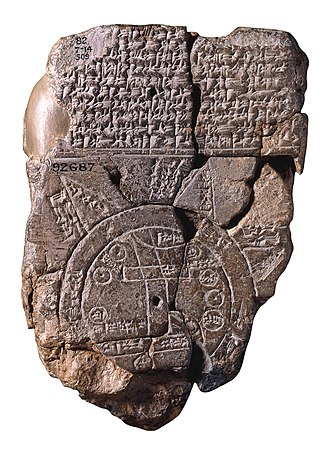
The hole in the Babylonian map of the world

Kahn mentions that the hole in the middle of the Babylonian map of the world was probably left by the scribes’ compass. However, the hole looks too deep and deliberate for that. The compass could have made a mark but such a deep mark would require a great deal of force and friction. The scribe only drew two circles using that centre point. Artistic geometers today speak of the symbolism of the compass’s central point (the pin)- the centre around which creation happens (like the arche in Greek philosophy). Perhaps it was no different for this scribe. Rather than being a mistake it may have been a deliberate act.

Kahn (1960 p 84f) writes that there is no good explanation for this hole except that it was left by a compass and D. J. Wiseman of the British Museum verified ‘the possibility that it represents the point where the compass pin was fixed.’

What would a meaningful universe look like?


In my book “Forgotten Connections” I pose the question. “If you could dream up the most meaningful universe possible what would you dream up?”

I ask this because to ask what is meaningful we must first define meaning. The Cambridge Dictionary defines meaning as “importance or value:” So when we ask about our meaning we are asking what makes us important or valuable.

It may be useful to list what could make you important of valuable? Let your imagination go wild here. We are trying to get an idea of what we mean by meaning. So by imagining maximum meaning we can assess if our own lives could potentially have even a fraction of that meaning.

To get an objective answer to this I asked ChatGPT. The advantage here is that ChatGPT spits out an answers based on all the content it has read. I encourage you to make your own list before reading ChatGPTs. We don’t want to let AI take away our ability to think in this way.

The exact question I asked ChatGPT was “If you could dream up the most meaningful universe possible what would you dream up?”

Here is its response in full…

“Dreaming up the most meaningful universe possible is a profound and subjective endeavor, as meaning can be interpreted in myriad ways depending on individual perspectives and values. However, if I were to imagine such a universe, it would likely incorporate the following elements:

  1. Consciousness and Awareness: Every being within this universe would possess a deep sense of self-awareness and consciousness. This would allow them to reflect upon their existence, contemplate the nature of reality, and seek fulfillment and purpose.
  2. Harmony and Balance: The universe would be characterized by a delicate balance between all its components, whether they are physical, biological, or metaphysical. Harmony would prevail among different species and ecosystems, fostering cooperation and mutual respect.
  3. Infinite Growth and Learning: Beings within this universe would have infinite potential for growth and learning. They would be driven by curiosity and a thirst for knowledge, constantly pushing the boundaries of understanding and creativity.
  4. Empathy and Compassion: Empathy would be a fundamental aspect of existence, leading beings to genuinely care for one another and strive for the well-being of all. Compassion would guide interactions, fostering kindness, generosity, and cooperation.
  5. Meaningful Connections: Relationships and connections would be deeply meaningful and fulfilling, transcending mere physical or superficial interactions. Beings would forge profound bonds based on shared values, experiences, and emotions.
  6. Freedom and Autonomy: Individuals would have the freedom to pursue their own paths and make choices that align with their values and aspirations. Autonomy would be respected and upheld, allowing for personal growth and self-expression.
  7. Unity in Diversity: Diversity would be celebrated and valued, enriching the fabric of the universe with a tapestry of cultures, perspectives, and experiences. Despite differences, there would be a sense of unity and interconnectedness among all beings.
  8. Purpose and Fulfillment: Each being would have a unique purpose or calling, contributing their talents and abilities to the greater good of the universe. Fulfillment would come from living authentically and making meaningful contributions to the world around them.
  9. Transcendence and Spiritual Growth: The universe would offer opportunities for spiritual growth and transcendence, allowing beings to explore the deeper mysteries of existence and connect with something greater than themselves.
  10. Eternal Legacy: The impact of individuals’ actions would ripple throughout eternity, leaving a lasting legacy that enriches the fabric of the universe for generations to come.

In this imagined universe, meaning would permeate every aspect of existence, from the smallest interactions to the grandest cosmic phenomena, fostering a profound sense of purpose, connection, and fulfillment for all beings within it.”

Some questions to consider…

How did your list compare with ChatGPTs?

Does this change how you think about meaning?

What could you do to add meaning into your life?

P.s. This extract from the Wikipedia page on “The Meaning of Life” may be of interest: “The meaning of life can be derived from philosophical and religious contemplation of, and scientific inquiries about, existence, social ties, consciousness, and happiness. Many other issues are also involved, such as symbolic meaning, ontology, value, purpose, ethics, good and evil, free will, the existence of one or multiple gods, conceptions of God, the soul, and the afterlife.”

How To Change Perceptions Of Disability

“Mastering others is strength. Mastering yourself is true power” Lao Tzu

It’s understandable to wish other’s attitudes would change. This would certainly solve the problem. However, it’s debatable how possible this is. Often movements who push people towards acceptance end up having the opposite effect. Aldous Huxley called this the law of reversed effort. Try to force yourself to go go sleep. It get’s harder. Likewise, if you start arguing with someone you often end up with them becoming more defensive than they were in the first place.

One may opt for the iron fist approach. Silencing or punishing anyone that discriminates. However, that would only remove discrimination from the outer world, not the inner world. It would still be there, bubbling below the surface. Ready to blow when triggered. 

Furthermore, there are two things that you can never force on others. 

1. You can’t force someone to respect you. 

2. You can’t force someone to love you.

Ultimately, that is what we all want. 

So what’s the solution? Read on.

Interestingly, in many ways society has become more accepting of difference in the last century. However, this is a slow process and to think we will be able to completely squash an ancient evolutionary instinct may be wishful thinking. 

What can we do right now? We can take control and stop reacting negatively to the injustices of the world. See if you can become happy about your difference and happy in general. After all, part of the reason others pity you is because they assume your difference makes you unhappy. That’s certainly not a given and it’s useful for others to see that if we are to change perceptions. 

Similarly, people discriminate against you when they know it’s easy to effect your emotions. They know they can provoke a reaction. Don’t let someone’s insult turn you into someone worthy of pity or scorn. As Gandhi said, ‘No one can hurt me without my permission’. If you react positively instead of negatively you become what teens would call ‘cool’. If you can take more control over your thoughts and emotions then discrimination should be less of a problem for you. 

We all have our life challenges. Whether they are visible or not. And when you can bear them with a smile then that is the epitome of inspiration. And everyone benefits from that. 

In time, this may even lead to a change in perception society wide. After all, the best way to change hearts and minds is through leading by example rather than logical argument or shaming people into compliance. 

In recent years perceptions have started changing. A lot of that is down to an increased media presence for people with differences. But the people you put on TV still have to be a success in their own right. Or at least comfortable in their own skin. That’s something up to us as individuals. Social media is surpassing traditional media in many ways, and in that domain, unless you are a competent creator you will get no where. So become good at something you are passionate about and see where that leads you. 

Someone who had a big impact on the public’s perceptions of disabled people was Stephen Hawking. Arguably the most well known physicist and science writer of his generation. At age 21 while studying at Oxford University he was diagnosed with a rare early-onset form of motor neurone disease. Over decades this gradually paralysed him, leaving him in a wheelchair and communicating through a speech-generating device.  But this didn’t stop Hawking. He continued his work as a physicist and writer for decades after. He didn’t let his disability define him and in doing so changed the perception of people with disabilities. He did this simply by being himself and pursuing his purpose. He preferred to be regarded as “a scientist first, popular science writer second, and, in all the ways that matter, a normal human being with the same desires, drives, dreams, and ambitions as the next person.” 

It may be easier to wish others would change but this is a chicken and egg situation. Let’s take the empowered path and focus on what we can control. Over time this should inspire more and more role models and in doing so create a virtuous circle. 

Be the change you want to see.

Why Do We Feel Self-Conscious?

Young children don’t feel self-conscious. Neither do wise people. Think of the wisest person you know of. Would they care so much about what you are worrying about? Probably not.

So what’s the difference between you and them? You view the world through the perspective of hierarchy. Young children haven’t learnt to do this yet whilst wise people have realised the illusion. 

When you look at the world this way you colour everything. It’s as if objects that hinder your goals are seen in a dark light and objects that help, appear with a halo on top. All else is blurred out. It is a world of snakes and ladders. Everything else is inconsequential and therefore largely ignored. Other people are our competitors in this game. By comparing ourselves with them we can see how we are getting on. 

Viewing the world this way allows us to survive and make progress. If we paid attention to everything we saw it would be overwhelming. We wouldn’t be able to focus on anything. Viewing the world in terms of hierarchy allows us to navigate it. We need to be able to rank the things we see so we know what to focus on. 

However, just because this strategy allows us to navigate the world does not mean we should confuse it with the real world. It is a distortion of reality. A useful one. But still a distortion. As Korzybski aptly wrote, ‘the map is not the territory’. Yet too often we confuse the map with reality. 

Psychologists often talk about two kinds of consciousness. When we see the world in terms of hierarchy we are more likely to use what is called spotlight consciousness (narrow focus). As opposed to lantern or floodlight consciousness (broad focus). We use spotlight consciousness when we focus on tying our shoelaces. For that moment our mental representation of the world is dominated by the shoelaces. As if a spotlight is focused on them and that’s all we see. Conversely, when we are focused on nothing in particular we see everything. The world we are conscious of gets bigger. In this case, it’s as if there is a floodlight. Illuminating everything equally. 

In floodlight consciousness you can’t prioritise, rank, or focus. Just as a spotlight is useless if the area is floodlit. Enlightened people can access this state of mind at will. Perhaps it is no mistake the word ‘enlightened’ contains the word ‘light’. 

The problem facing most people is that they are trapped in spotlight consciousness. You focus on one thing one moment and another thing the next. You are embroiled in life. Never being able to step back and look at things objectively. It’s as if your conscious world has been condensed to the size of a football and you have no control over where you are kicked to next. You move away from pain and towards pleasure. This isn’t free will. Your strings are being pulled by emotional drives embedded in us as a result of evolution and upbringing. If you aren’t pulled around by pleasure and pain you decide you may as well be present in this moment. 

You can only be truly free in the present moment. If you are in floodlight consciousness you are present. The present is a state of no time. When you are truly present you are not thinking of the past (regret) or thinking of the future (stress). In this state the past and future don’t exist. So even if you could focus on your wonky nose you wouldn’t worry about fixing it because that would require thinking of the future. Which you can’t do unless you come out of the present moment.

Viewing the world in spotlight consciousness is the heart of this problem. In floodlight consciousness it is logically impossible to be self conscious. If we are to have the thought that other people think my nose is ugly then we must be able to focus for at least a moment on your nose and on the idea of ‘other people’. And if you are deliberately focusing on something you are no longer in floodlight consciousness. Therefore, we cannot be self-conscious in floodlight consciousness as self consciousness requires focus.

Moreover, to be self conscious we have to first have decided which self to be conscious of. Why are we not worrying how our neighbour’s nose will look to other people? In floodlight consciousness you don’t prioritise yourself. You view the world in the third person. Like an artist looking over the scene they are painting. And you are just another character. Therefore, self consciousness is impossible. Side note: Isn’t it ironic that the more we care about ourselves the more self-inflicted suffering we put ourselves through? 

Self consciousness required focus. Focus is a useful tool but it’s like a knife. You need to know when to use it and when not to. A knife should be picked up for dinner and laid down after. If you go through your day using it for every task you face you’re asking for trouble!  

You Will Never Be Superior To Others. Equally, You Will Never Be Inferior

Behind everyone who behaves as if he were superior to others, we can suspect a feeling of inferiority which calls for very special methods of concealment. It is as if a man feared that he was too small and walked on his toes to make himself seem tall.

Alfred Adler. Austrian psychologist

Looking back on my life I realise I was covering up my perceived inadequacies with achievements. In my teenage years I became progressively more determined and relished in proving others wrong. I went from bottom of the class to the top. I went from never being picked for sports teams too being selected for the British Sailing Team. Instead of being a fun activity, sport became a way to top up my self esteem.

One might say; “but this mindset helped you become successful”. Indeed, it’s a common theme in the stories of “successful” people. It’s also helped me develop skills that I now enjoy putting to use. 

However, there’s no escaping the fact that the roots of such success are rotten and if one is to avoid blowing over in a future storm they must dedicate some time to healing their roots.

Success born out of inadequacies isn’t true success. In that you are simply reaffirming the inner narrative that you aren’t good enough. No matter how much you get from the outside world you will never heal the hole inside of you. 

We wouldn’t lust after the lives of many celebrities we look up to if we knew the self-hatred they carried within. However much someone has can they truly be called a success if they don’t have the most important thing? Namely, self-love. Losers therefore can never really win. And equally you don’t need to have a trophy in your hands to consider yourself a winner.

Furthermore, pursuing “success” this way is stressful. Tension comes when trying to fill the gap between who we are and who we want to be. The further these two are apart the more stress we feel. Because this gap will never be closed by external gain we are putting ourselves under eternal stress. Once our bodies are too fragile to achieve we lose what gave us our self esteem and are forced to make do with clinging onto memories of our past achievements. That is not success in my book.

One of the biggest regrets of dying people is that they missed valuable family movements because they were working. They realise they suffered because they accepted the wrong criteria of success. Namely, competing with others rather than sharing enjoyable moments with others.

THE DANGERS OF HIERACHY THINK

This mindset is a consequence of seeing the world in terms of hierarchies. We’ve accepted without question the rules of the game imposed on us by others. Namely, to be a success you must compete with others for prizes. Whether that be a sports day medal or an attractive mate.

If we look different from others we may be more likely to to believe in the hierarchy as we regularly see it applied by others onto us. Us humans are more susceptible to accepting the opinions of the group than you might assume. 

Social psychologist Solomon Asch famously showed that people were willing to ignore reality and give an incorrect answer in order to confirm with the rest of the group. People also have a commitment bias which means we try to double down on our past actions and look for evidence to support us acting that way.

In the same way those who look different from others are more likely to see the hierarchy in action. The extreme example of this is being bullied by others. Fighting back would have physical consequences so we do the alternative. We cower and pray for mercy. Just as one may throw themselves before a king. In this way we have affirmed the hierarchy to ourselves and we tend to find evidence to re-affirm this belief. 

At least in the modern world, violent bigotry is minimised by rules. This allows those at the bottom of the hierarchy to rise up the ladder. On the face of it this is a good thing but the idea of the ladder is built out of the fallacy of hierarchy. That we can achieve self esteem by being better than others.

Such thinking has consequences for us and those around us. We judge others worth by their position on the hierarchy as we do ourselves. This makes true friendship difficult. Alfred Adler wrote that all vertical relationships are unhealthy. Under hierarchy think all we have are vertical relationships. 

We assume that ‘different’ means better or worse as we are looking at the world through the glasses of hierarchy. Therefore, if others or ourselves look different we can’t accept there could be such a thing as equal but different. Doing so would be embarrassing and would mean we’d have to admit that we’d potentially wasted years of our life flogging a dead horse.

EXERCISE

Here’s a simple test: 

  1. Take 10 seconds and think positive feelings about yourself
  2. Now ask yourself how much of that 10 seconds involved reminding yourself or your achievements

If you wake up each morning reminding yourself what makes you valuable that is a sign that you don’t think you are enough. 

THE NEED TO PROVE YOURSELF

“Don’t try to impress people. Always be yourself!

Bella Thorne

Proving yourself to others can be a fun challenge but many waste years of their life doing this. Not living life on their own terms.

It’s true that no matter how disabled or different you look, if you become very good at a skill others will come to respect you. Or may at least change their flawed opinion that you were less able than you actually were.

But living life this way is a strategy doomed for failure from the outset. There will always be new people who you need to prove yourself to. And those strangers you fear the options of; there will always be more of them who remain to see you as inferior because of your differences. Very few people are so famous that their achievements are known by everyone. 

And even if you did manage to make your achievements known worldwide would it be worth it? For all that strength you showed you remained weak in the area that counted most. It is a weak man indeed, that lives for the adoration of those that once looked down upon him. 

Realise that you are living a life rooted in the base instincts of humans. The hierarchy view of the world is grounded in evolution which is by definition animalistic. It’s a programme our nature and nurture has taught us to run. That is what children do before they  learn to think for ourselves. Some never do.

If we accept that by achieving to prove others wrong we are only appealing to the immature side of others then why live your life to fit in with that? Humans also have a logical side and a loving side. These parts of us that really make us valuable as humans. So, if you have to live life on others terms live it to prove them wrong. But then you realise that those that are loving and those who are philosophical don’t care where you are on the hierarchy.